Articles
Cold Outbound is Broken. Context is the New Currency.
Why the difference between a 3% and a 14% reply rate isn't copywriting -it's whether your first line proves you were actually paying attention.
Most cold outbound feels like a stranger yelling your first name in a crowded room. You technically recognize it, but you have no idea who they are or why they're talking to you. The recognition triggers a response - but not the one anyone intended. You look away.
That is the fundamental crisis of modern B2B outreach. Not deliverability. Not subject lines. Not send-time optimization. The crisis is relevance - and more specifically, the complete absence of it in the vast majority of cold campaigns being sent today.
The data, when you look across hundreds of campaigns and millions of sends, is brutally unambiguous. Context-free outreach sits at around 3% reply rates. Contextual outreach regularly clears 12–14%. That is not a nice bump. That is a different economic reality - one that determines whether outbound is a viable growth channel or an expensive exercise in attrition.
The Numbers Don't Lie - They Just Sting
The Instantly Benchmark Report 2026, which analyzes billions of cold email interactions across thousands of active workspaces, puts the platform-wide average reply rate at 3.43%. Elite senders - defined as the top 10% - exceed 10%. The gap between average and elite isn't luck. It's architectural.
Belkins' 2025 study of 16.5 million cold emails across 93 domains confirms the trend: average reply rates have declined year-over-year, sitting at 5.8% in 2024 versus 6.8% in 2023. The environment is getting harder. The only way to beat a harder environment is to get smarter - not louder.
Hunter.io's State of Cold Email report adds a critical behavioral dimension: 61% of decision-makers cite lack of relevance as the reason cold emails fail. A larger share - 65% - say emails feel too pushy or sales-focused. The problem isn't volume. The problem is that most cold outreach demonstrates, in its very structure, that the sender doesn't actually know anything about the person they're messaging.
What "Contextual" Actually Means?
The word "personalization" has been so abused that it has lost almost all meaning. Inserting {{first_name}} and {{company}} into a template is not personalization. It is automation with a mask on. Decision-makers see through it instantly - and 69% of US-based decision-makers say it bothers them when AI was used to write the email, signaling a market-wide allergy to the synthetic and the templated.
True contextual outreach means your first line references something the prospect actually did. Not a job title. Not their company funding round from 18 months ago. Something real, recent, and specific to them.
Two categories where this changes everything
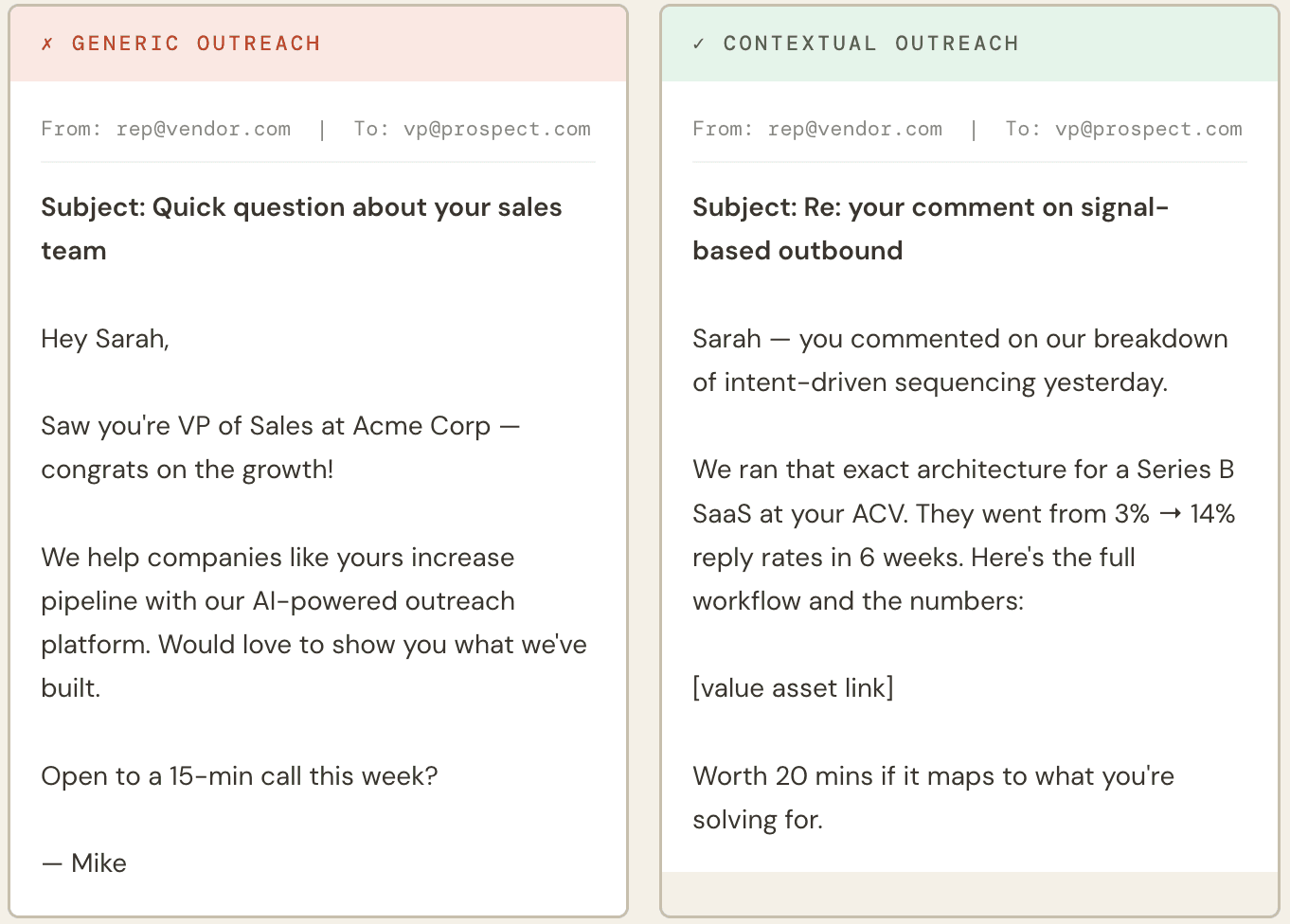
Content-based context: "You commented on our breakdown of signal-based outbound yesterday - here's how we ran that exact playbook for a company your size, with the numbers." This works because the prospect already raised their hand. They expressed interest in a specific idea. Your outreach doesn't interrupt - it continues a conversation they started.
Partner-based context: This is where the math becomes genuinely compelling. When you know a prospect has already invested in a complementary category - through a partner, integration, or co-sell relationship - you can open with: "You already invested in [Category A] with [Partner X] - here's what companies in your exact situation do next to unlock [Outcome B]."
The reference point in that message is not a like on a LinkedIn post. It is a purchase decision they already made. That signal carries a fundamentally different level of intent. And your opening line carries three things that generic cold outbound almost never has simultaneously: context, credibility, and immediate value.
The Architecture: Content → Ads → Intent → Outbound
One of the most durable misconceptions in B2B is that these motions - content marketing, paid advertising, intent data, and cold outbound - are separate strategies competing for budget. They are not. They are sequential layers of a single conversion engine. And when assembled in the right order, they create something genuinely powerful: outbound that doesn't feel cold.
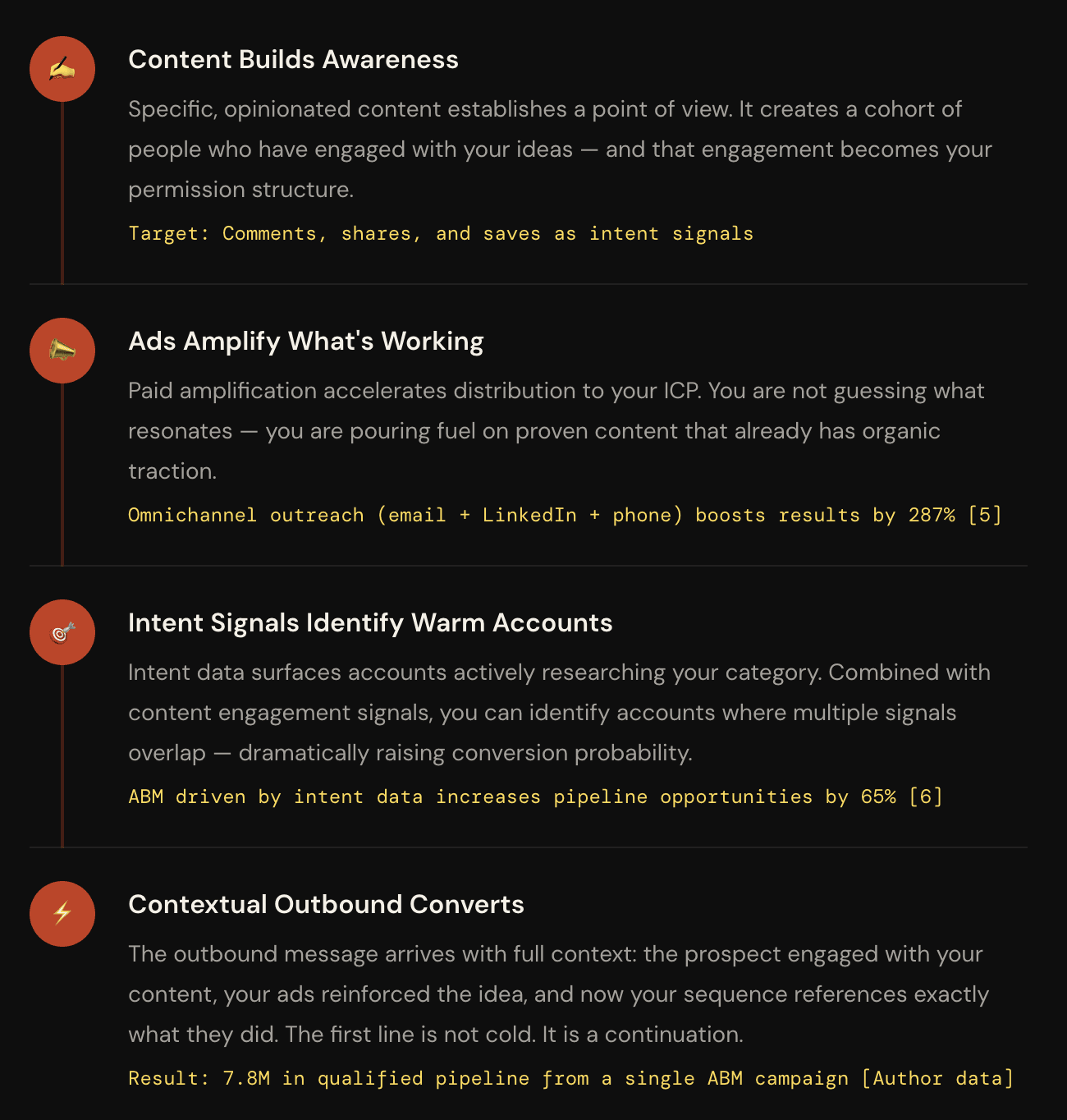
The key insight in this architecture is that the contextual outbound step is doing the closing work - but the content and ad layers are doing the qualification work first. By the time outbound touches an account, you are not introducing yourself to a stranger. You are following up with someone who already knows what you do and has demonstrated interest in the specific problem you solve.
Why ABM Built on This Architecture Works
Account-Based Marketing, when built on the signal-based architecture above, stops being a theory and becomes a compounding machine. The numbers from the wider ABM research ecosystem reinforce this:
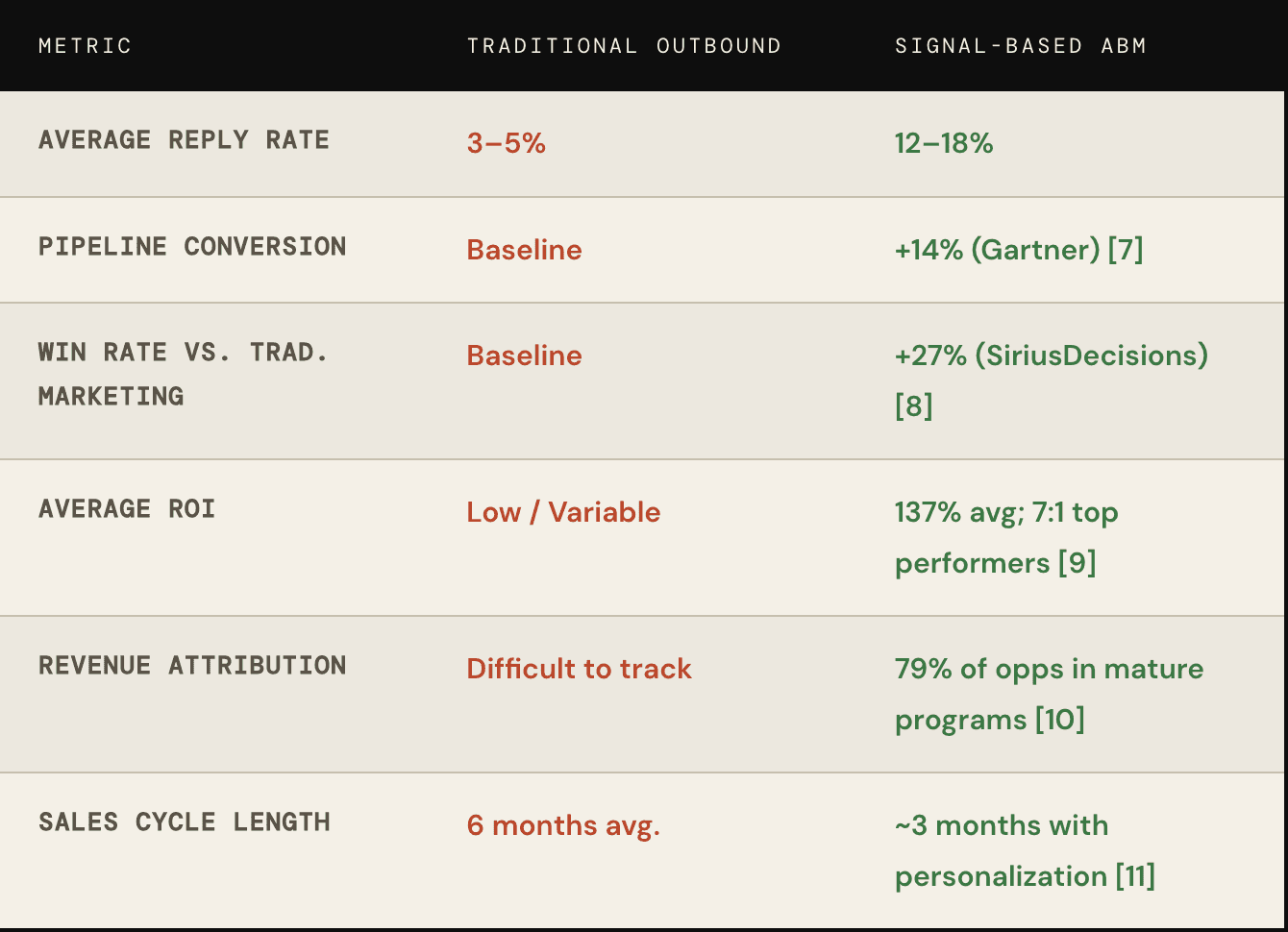
The most striking data point: 82% of organizations reported ABM delivers higher ROI than conventional initiatives, with nearly half citing it as the single highest ROI source in their entire marketing mix. The estimated average ROI from ABM programs in 2025 is 137% — and top-performing programs achieve a 7:1 return on investment according to TOPO's 2024 benchmark report.
The Value Asset: Why Naked Asks Fail
There is one more architectural principle that separates high-performing contextual outreach from its imitations: where the call-to-action lives.
In generic cold outreach, the ask is naked. "Open to a 15-minute call?" arrives before you have given the prospect a single reason to invest 15 minutes. The asymmetry is obvious to them, even if it isn't obvious to the sender.
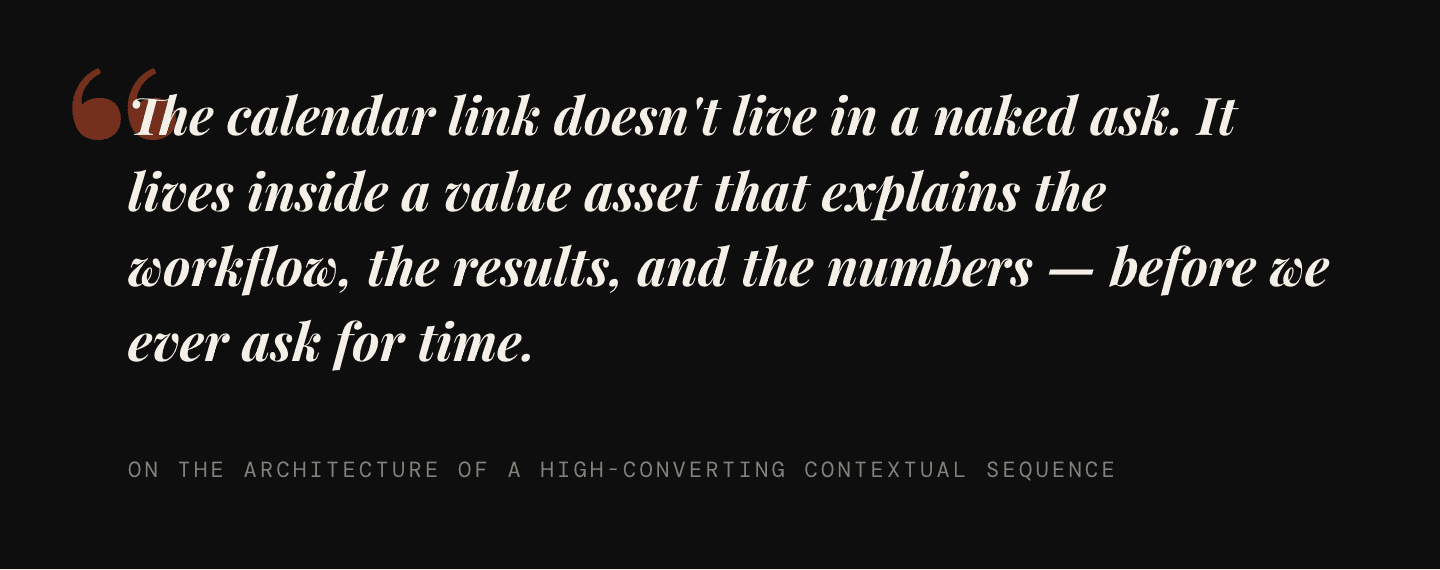
In contextual outreach built for conversion, the calendar link lives inside a value asset. Before you ask for time, you give something of genuine value — a workflow breakdown, a case study built specifically for their company size and situation, a benchmark report relevant to their stage. The asset does three things simultaneously:
Demonstrates expertise without asserting it. You don't claim to know their problem - you show evidence of having solved it for others like them.
Creates reciprocity. You gave something useful before asking for anything. The psychological contract is fundamentally different.
Pre-qualifies interest. Someone who reads the workflow and asks for a conversation is a dramatically warmer prospect than someone who responded to a cold ask.
Hunter.io's data on decision-maker preferences confirms this directionally: open-ended CTAs outperform hard asks - "Can I send more info?" and "Open to learning more?" are consistently preferred over "Book a call with me" as a first touch. The value asset is the mechanism that makes a softer CTA feel satisfying rather than evasive.
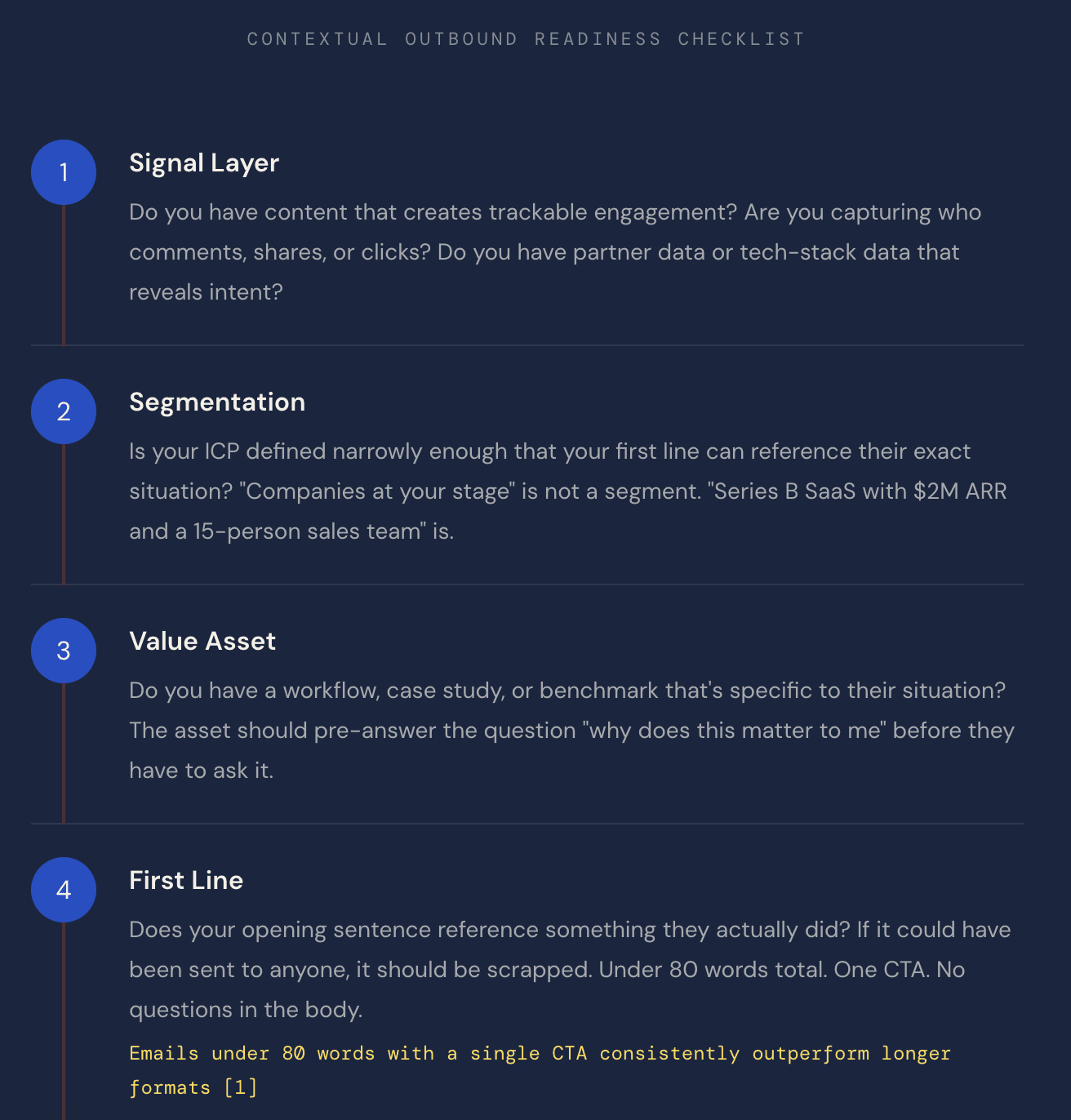
Putting It Together: The Checklist
If you're rebuilding your outbound motion around context rather than volume, here is the architectural checklist - drawn from the campaign data and the broader research:
The Only Question That Matters
Everything in outbound strategy eventually reduces to a single question: does your first touch show you were actually paying attention?
Same ICP. Same product. Same founders. The difference between a campaign that generates 3% reply rates and one that generates 14% - and builds $7.8M in qualified pipeline — is whether you can answer that question with yes.
The market is not getting easier. Inboxes are saturated. Buyers are allergic to the synthetic and the templated. The arms race on volume has already been run - and the winners weren't the ones who sent the most emails.
The winners were the ones who showed up with context.