Articles
The Contract Is the Starting Gun, Not the Finish Line
Most sales teams celebrate the close and disappear. The companies that compound their growth understand that the real work and the real referrals begin the moment a customer signs.
There is a ritual that plays out in sales teams everywhere, every single day. The deal closes. Slack lights up. The team celebrates. And then, almost imperceptibly, the attention shifts — to the next prospect, the next pipeline, the next commission. The customer? They get handed off to Customer Success with a wave and a hope.
It is a costly ritual. Not because it feels wrong - it feels completely natural but because what happens in the 90 days after a contract is signed is often the single biggest determinant of whether that customer renews, expands, and sends you their peers. Most sales organizations are flying blind during this window, celebrating a close that has, in reality, just become a starting gun.
The Handoff Problem Nobody Talks About
When a deal closes, the organizational chart becomes the enemy of the relationship. Sales moves on. CS inherits the account, often with incomplete context about why the customer bought, what problems they're truly trying to solve, and what promises (explicit or implied) were made during the sales process.
Research from Rocketlane found that 77% of B2B buyers describe their most recent purchase experience as difficult or complex. A large driver of that friction? The jarring discontinuity of the handoff. From the customer's perspective, the people who understood their problem have disappeared, replaced by a new team asking them to repeat the same explanations all over again.
The numbers confirm what most revenue leaders feel in their gut. According to Avoma, a disjointed onboarding experience one that doesn't sync with the expectations set during the sales cycle is one of the top drivers of early churn. And the math is unforgiving: losing just 5% of paying subscription customers each month compounds to nearly a 50% annual churn rate.
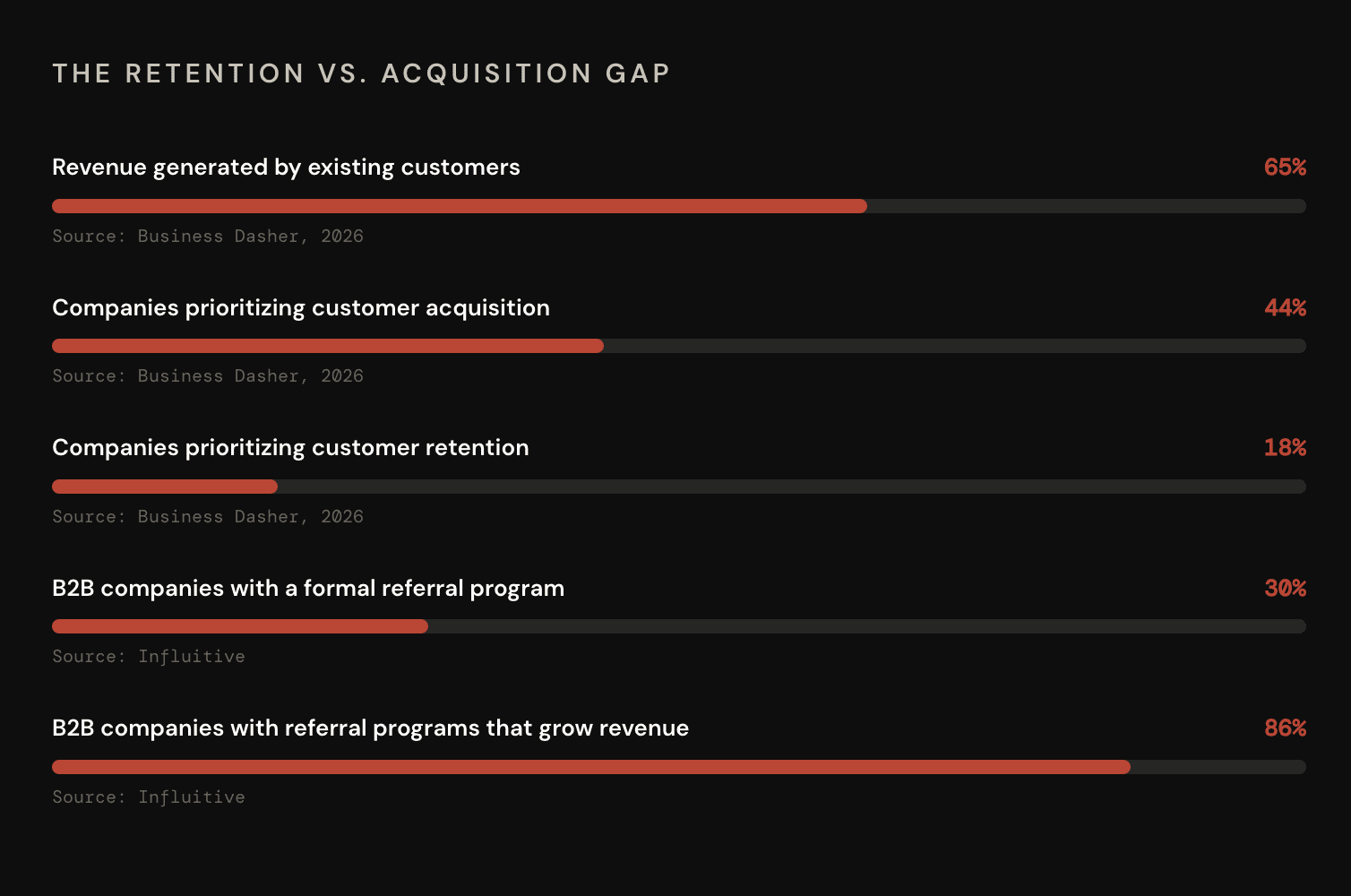
Meanwhile, only 18% of companies prioritize customer retention versus 44% who primarily chase acquisition - despite existing customers generating roughly 65% of a company's total revenue, according to Business Dasher's 2026 retention research.
The 90-Day Rule: Show Up With Something Useful
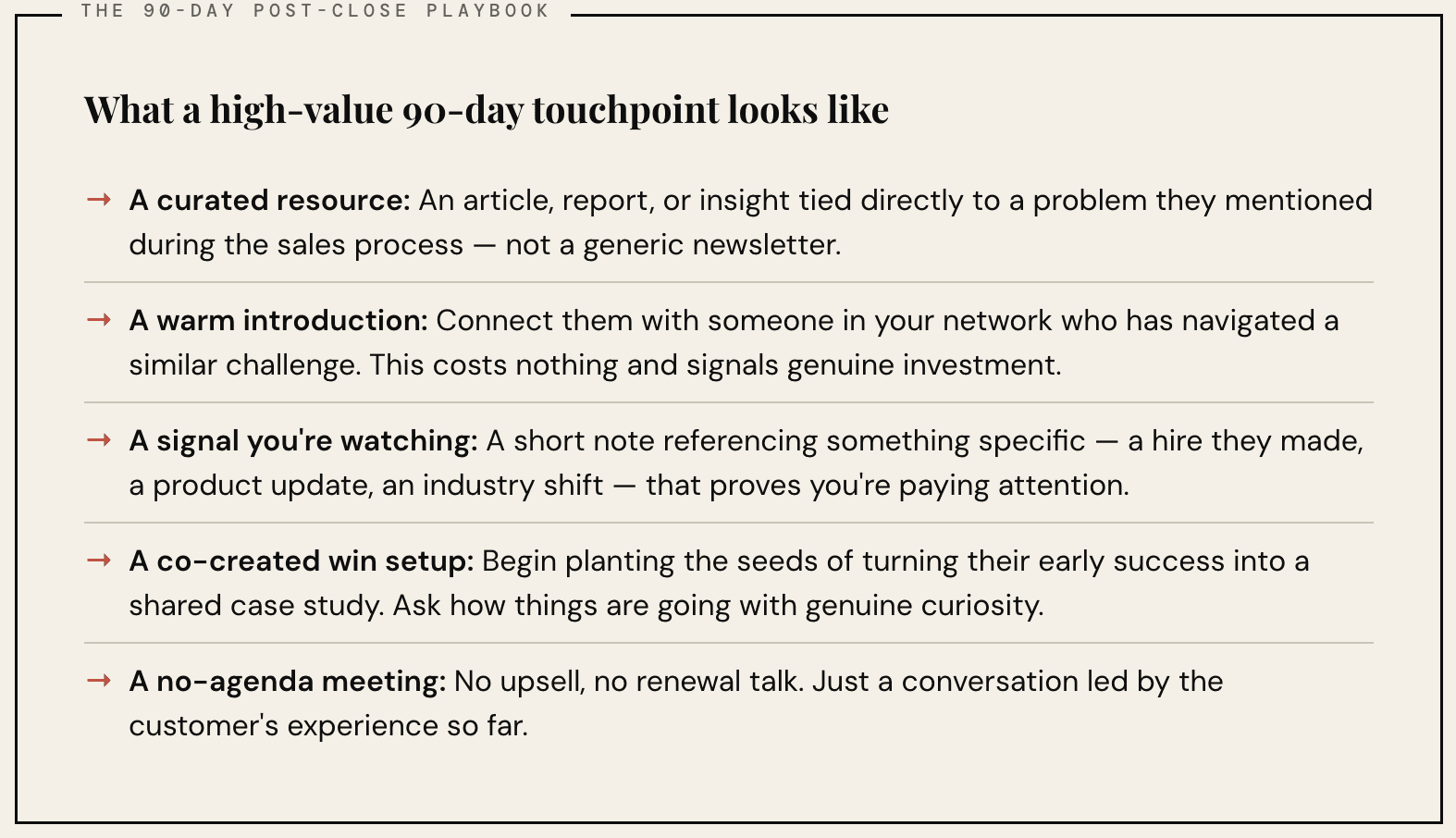
When running sales, one practice proved consistently effective above all others: the founder or CRO shows up 90 days post-close with something actually useful. Not a check-in call masked as a renewal conversation. Not a health score survey. Something that demonstrates you're still thinking about their problem, not just their invoice.
That might be an article tied directly to a challenge they mentioned during the sales process. A warm introduction to someone in your network who faced the same operational obstacle. Or simply a short note that proves you paid attention - that you remember what they were trying to fix and you've been watching their situation.
This isn't just good manners - it's economics. Bain & Company research shows that a 5% increase in customer retention can drive a 25–95% increase in profits. And companies with proactive customer success motions see 20–30% lower churn than those relying purely on reactive support.
Escalations Aren't Failures. They're Opportunities.
Here is a counterintuitive truth that runs against every instinct sales leaders have: your most difficult customers in year one can become your most powerful advocates in year two. But only if you handle the difficulty correctly.
The temptation when a customer escalates - once, twice, three times - is to go defensive. To offer discounts. To assign blame internally. To quietly hope the situation stabilizes before renewal. This is the wrong move every time.
The mechanism here is not mystery. When a customer has struggled and you've helped them succeed in spite of it, they have a story. A real one, with friction and resolution. That story - far more than a smooth, uneventful deployment - is the kind customers tell their peers unprompted at conferences, in Slack communities, and over dinner. Struggle-to-success is a narrative arc that sticks.
What this requires is treating escalations not as threats to the account, but as raw material. Each escalation is a chance to understand something important, move fast, fix something together, and ultimately give the customer a win they can claim credit for.
Referrals Are a Side Effect, Not a Tactic
Most referral programs are designed with the transaction in mind. Here is a link. Here is a code. Here is a discount for you and your friend. They are, at their core, an ask - and customers know it.
The best referrals don't come from branded programs or tracking links. According to Referral Rock, 91% of customers say they'd give referrals, but only 11% of salespeople ever ask. The problem is not willingness. The problem is timing and framing.
The referrals that compound - the ones that generate four more in a year - almost always show up after a specific, visible win. A metric that moved. A process that got fixed. A team member who got promoted because of the work they did with your product. That is the moment.
And the way you harvest it is not by asking for a referral. You ask if you can write it up as a case study. You offer them visibility and credit, not work. You say: "What you've built here is impressive. I'd love to tell this story publicly - would you be open to being featured?"
That offer - public proof, professional credit, a document they can share with their own leadership - is where the relationship deepens and the referral engine turns on. Not because you asked. Because you made them look good first.
The Case Study Is the Referral Engine
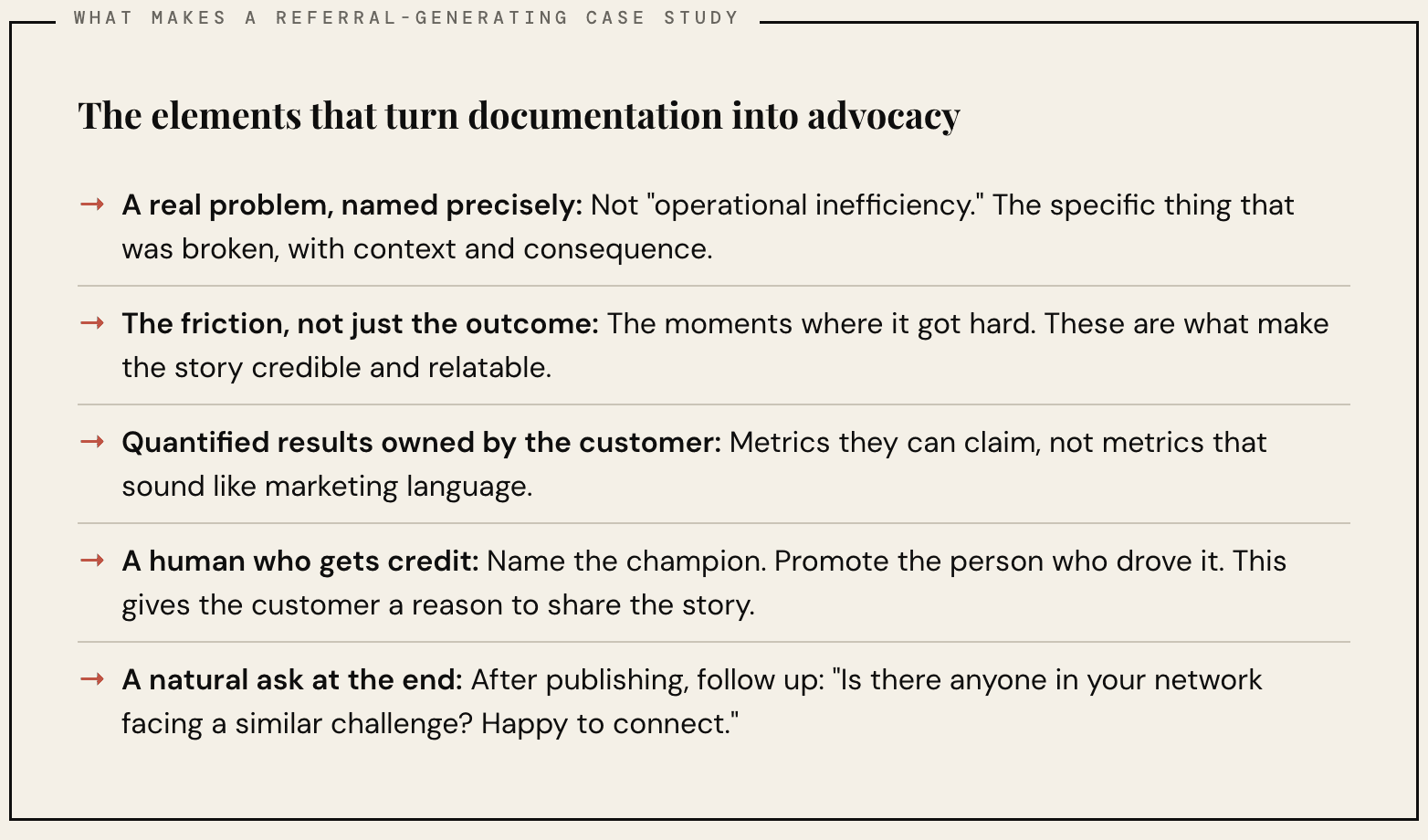
Co-created wins deserve public documentation. Not just for social proof — though 88% of B2B buyers seek peer validation before a financial decision — but because the act of creating a case study deepens the relationship itself.
When you sit down with a customer to document their success, you are doing several things at once. You are forcing both sides to articulate what actually changed and why. You are giving the customer's team something to present internally to justify the investment. You are creating a piece of collateral that does your outbound work for you. And you are, quietly, turning a customer into a co-author - someone with skin in the success story.
Research from Firework shows that referred customers are four times more likely to refer others, creating a self-sustaining cycle of growth. The first referral from a customer doesn't just bring one new logo - it seeds a cohort. Done consistently, the referral conversation stops being something you have to have. It's already been had, upstream, by people who trust each other more than they'll ever trust your sales deck.
What This Looks Like Operationally
None of this is soft. It translates directly into operational decisions that revenue leaders make every week. Tie at least part of AE compensation to retention metrics or NPS scores at 90 days. Create a mandatory 90-day post-close touchpoint from the founder or CRO for any account above a defined threshold. Build a case study pipeline as a core CS function, not a marketing afterthought. Track escalations to advocacy - it's one of the most powerful leading indicators of referral velocity you'll never see on a standard dashboard.
Companies that treat the handoff as a partnership - introducing CS during the sales process, not after signing - see dramatically better outcomes. Loom, for example, introduces their CS team to buyers during the sale itself, ensuring continuity before the contract is even signed. The relationship doesn't start at the handoff. It starts the moment a prospect believes you'll still be present after they pay.