Articles
Stop Running Three Funnels. You Only Need One.
How smashing the content/ads/outbound silo turned a stalled $1M SaaS into a $4M growth engine and why every impression you post is a lead signal you're currently ignoring.
One of the biggest "aha" moments in modern B2B growth is realizing that most teams are running three separate funnels where there should be one. Content sits in one corner. Paid advertising operates in a completely separate universe. Outbound sales teams work a third pipeline that has no idea what the other two are doing.
Then leadership wonders why customer acquisition costs keep climbing and nothing feels predictable.
This isn't a niche problem. According to the Content Marketing Institute's 2024 B2B Benchmarks Report, content still isn't treated as a coordinated business function in most organizations. The symptoms are everywhere: duplicated spend, missed signals, SDRs cold-calling people who already engaged with your LinkedIn posts three weeks ago.
The Silo Problem Is a Unit Economics Problem
When content, paid, and outbound operate independently, the financial damage is structural. CAC climbs because you're paying for warming that content already did for free. Reply rates crater because SDRs fire cold sequences at people who have actually been warming in your orbit for months. Paid budget gets wasted blasting net-new strangers when the highest-intent audience - people who liked your post last Tuesday is sitting unaddressed.
The median SaaS company now spends $2.00 to acquire every $1.00 of new ARR — a 14% year-over-year increase. Meanwhile, the average cold email reply rate has fallen from roughly 7% in 2023 to 3.43% in 2025–2026, with about 19 out of every 20 cold emails getting ignored entirely.[3] These two numbers are connected. Teams keep throwing more volume at a broken system rather than fixing the system itself.
⚡ Key Data Point
Content marketing generates 3x more leads than traditional marketing and costs 62% less - yet only 31% of B2B organizations say they have the right technology to actually act on those signals across the organization. (HubSpot / Demand Metric via MSMC, 2024)
The Tactical Pivot: One System, Not Three
The shift from $1M to $4M ARR detailed in the practitioner playbook that inspired this piece came down to a single structural change: smashing the silos into one unified system where every touchpoint fed every other touchpoint.
The core insight was that LinkedIn activity - every like, comment, and profile view is not "brand activity." It's purchase intent data. Every interaction is a weak signal that, when enriched and aggregated, becomes a qualified lead.
Step 1 - Turn Content into Signal Capture
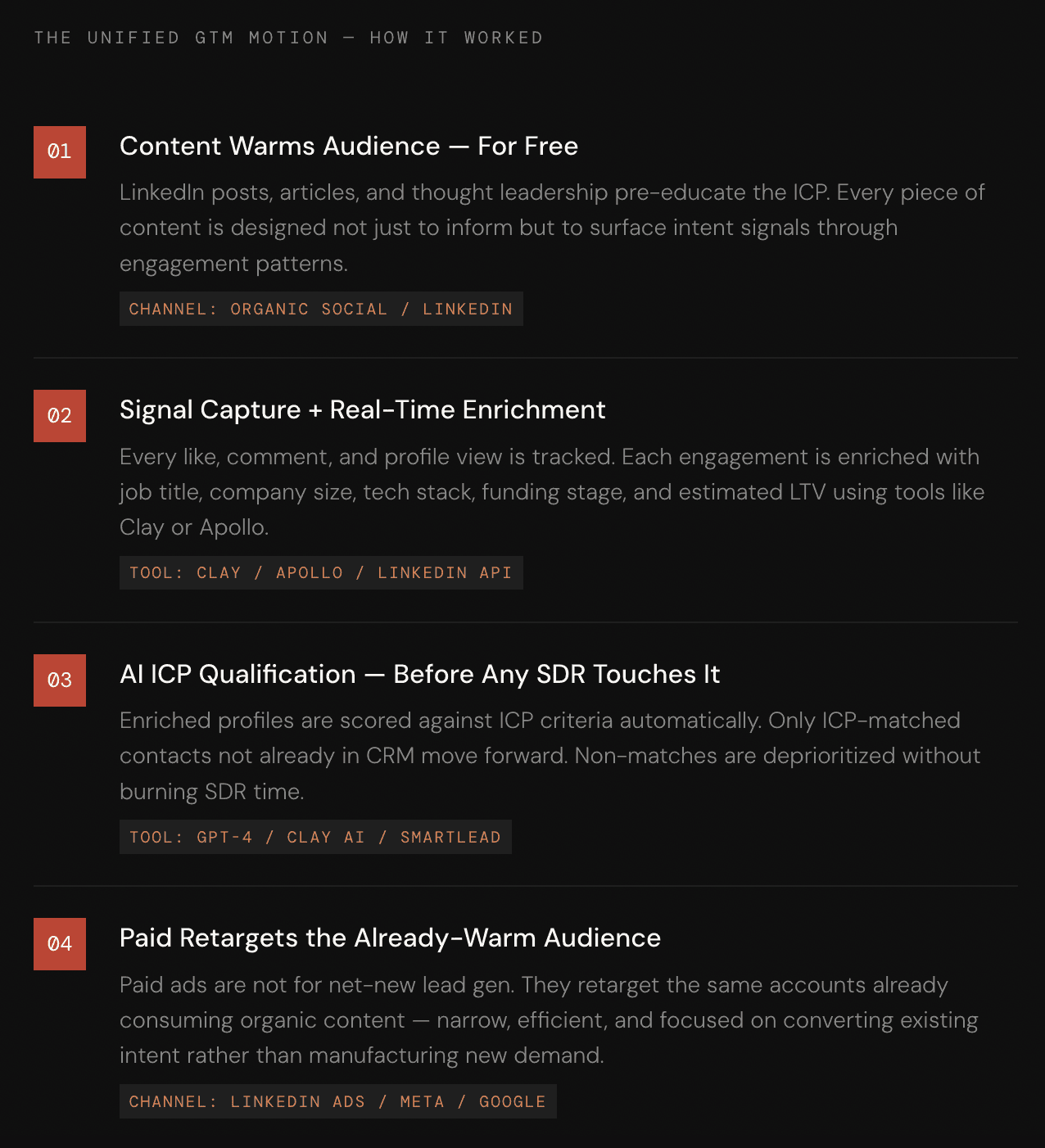
Every post on LinkedIn became a data source. Engagements — likes, comments, and profile views — were tracked systematically and enriched in real time with firmographic data: job title, company size, tech stack, funding stage, and estimated LTV.
This isn't hypothetical. A recent Gartner survey found that sellers using AI-assisted signal tools are 3.7x more likely to meet their quota than those who don't.The enrichment step is where most teams leave money on the table - the signal exists; they just never capture it.
Step 2 - AI Qualification Before Any Human Touches It
Every enriched engagement was run through an AI qualification layer before a single SDR was involved. If the contact matched the ICP profile and wasn't already in the CRM, they went straight into a warm sequence - one that referenced the exact post they had engaged with.
This is the key personalization lever. Research confirms that personalization depth drives 52% higher reply rates, and smaller, highly targeted campaigns outperform broad blasts by 2.76x.[5] Referencing the specific content someone engaged with isn't just personalization - it's context, and context is trust.
Step 3 - Paid as Retargeting, Not Prospecting
The reframe here is critical. Paid media was not used to find new audiences - it was used to stay in front of audiences already consuming organic content. This flipped the economics of paid entirely.
The data supports this approach. LinkedIn ROI (113%) now exceeds Google Ads (78%) for B2B SaaS when targeting precision is applied, despite higher cost per click.Tight audience retargeting is where that precision lives. 84% of B2B marketers already identify LinkedIn as the most valuable distribution channel - the problem is most aren't closing the loop between who engaged and who gets retargeted
The Impact on Unit Economics
A 14%+ reply rate is meaningful context against the backdrop of industry benchmarks. The platform-wide average for cold outreach sits at 3.43%, with top performers breaking 10%.[3] Context-rich warm sequencing - where you reference the prospect's own engagement with your content — consistently outperforms because it isn't cold. By the time an SDR sends that first message, the prospect has already self-identified as interested.
Why This Works: The Buyer Journey Reality
The average B2B customer journey involves 76 touches before purchase over 211 days. Content, ads, and outbound working independently compete for the same 76 touches rather than compounding them. A unified system means every touch reinforces the last one - cutting time to conversion while improving signal quality. (SaaS Marketing Statistics, 2026)
The Tool Stack Reality
A common objection to this approach is cost. But the practitioner case that inspired this piece ran the entire system on a stack that cost "less than many teams' SDR swag budget." The tools required to execute this are not enterprise-grade procurement decisions:
The core components: a signal capture layer (Phantombuster, Taplio, or native LinkedIn analytics), a data enrichment tool (Clay is the current standard), an AI qualification layer (GPT-4 via Clay automations or a custom prompt chain), a sequencing platform (Instantly or Smartlead for email; Expandi or Dripify for LinkedIn), and a CRM (HubSpot Free or Pipedrive).
None of these require enterprise contracts. The unlock isn't budget - it's architecture.
Why Most Companies Are Still Getting This Wrong
Most companies today are sitting on millions of impressions and tracking none of them. They keep asking "how do we scale outbound" while posting every day into a black hole, generating data they never use.
The root cause is organizational. Among companies with 100+ employees, content teams, demand gen teams, and sales teams typically operate as separate functions with separate goals and separate tooling. Each team optimizes for its own metrics: content measures impressions and engagement rate; paid measures CPL; outbound measures meetings booked. Nobody owns the compound result.
91% of B2B marketers use content marketing, but only 31% say they have the right technology to manage it across the organization. That gap between creating content and actually instrumenting it as a demand engine is where CAC lives.
How to Start: A Practical Playbook
You don't need to rebuild your entire GTM motion in a quarter. The compounding effect starts as soon as you connect the first signal to the first action:
Week 1: Instrument your LinkedIn posts. Export every liker and commenter manually or via a tool like Phantombuster. Run the list through Clay to enrich with firmographic data. Find out who is actually engaging.
Week 2: Build a simple ICP filter. Define three to five firmographic criteria that qualify an account. Run your enriched engagement list through it. You likely already have 20–50 warm, qualified contacts you've never reached out to.
Week 3: Write one sequence that opens with a reference to the specific post they engaged with. Don't pitch. Ask a question. Research confirms that timeline-based messaging - referencing a specific shared context - outperforms generic problem-statement hooks by 2.3x in reply rate.
Week 4: Create a LinkedIn retargeting audience from your engaged accounts. Serve them one piece of content that advances the conversation. Ads are the reminder, not the introduction.
Once you've run a single cycle of this loop, the results will make the case for scaling it.
The Compounding Effect
The reason this works over time isn't any individual tactic - it's the compounding logic. Every piece of content you post becomes slightly more valuable because it feeds the enrichment layer. Every enriched contact improves your ICP model. Every personalized outbound message improves your reply rate data, which tightens your sequence. Every retargeting campaign narrows on higher-intent accounts, reducing CPL.
None of these loops exist when content, paid, and outbound are siloed. All of them exist when the system is unified.
SEO and content marketing deliver 702% ROI for B2B SaaS companies with a break-even time of just seven months - dramatically outperforming paid acquisition channels in isolation. But those numbers assume the content is doing something after the impression. Most companies don't let it.
"Most companies are sitting on millions of impressions and tracking none of it. They keep asking how to scale outbound while posting every day into a black hole."
The playbook here isn't sophisticated. It requires no new budget, no new headcount, and no six-month implementation project. It requires treating every impression as a data point, connecting the data to a qualification layer, and letting the output drive outbound and paid simultaneously.
Three funnels are three times the leakage, three times the inefficiency, and three times the noise. One system compounds. The choice is mechanical, not philosophical.